
Copiah County Arrest Records and Court Charges
An arrest record is the account of an arrest itself. It shows who was taken into custody, the arresting agency, the date, and the booking details logged at the jail. In Copiah County, most arrests run through the Sheriff's Office under Sheriff Byron Swilley, though city police and other agencies make arrests too. The booking side of an arrest, including custody status and bond, sits with the jail, not the court. For the jail roster and booking detail, the Copiah County inmate records are the better place to start.
A court charge record is a different thing. After an arrest, a prosecutor decides the formal charges and files them with the court. In Copiah County, misdemeanor charges often begin as sworn affidavits in Justice Court. Felony charges move toward the grand jury and Circuit Court. District Attorney Daniella M. Shorter prosecutes felonies for Copiah and two neighboring counties. The charges, once filed, are tracked through the case as it proceeds. These court charges after arrest are public, and they sit at the heart of any criminal matter. The full case file, including pleas, verdict, and sentence, is kept in the Copiah County criminal court records.
How to Find Copiah County Arrest Records and Charges
Copiah County does not run a single public arrest database. Charges show up instead inside the court case file. Circuit and Chancery cases are part of Mississippi Electronic Courts, the statewide e-filing system. Public remote viewing runs through PAMEC, which needs a registered account and may charge per-page fees. For misdemeanor and traffic charges, the Justice Court office is the local point of contact, since many charges start there as affidavits. Booking and custody questions go to the Sheriff's Office or the jail roster instead.
- Open the Mississippi Electronic Courts portal and follow the PAMEC access path.
- Register or log in, then search by defendant name or case number.
- Open the matching case and read the list of charges filed.
- Check each charge for its statute code, severity level, and current status.
Some records are not online at all. When that happens, a written or in-person request to the clerk that holds the case is the reliable route. Bring the party names, a case number if you have one, a date range, and the record type you need. Justice Court charges, felony files at the Circuit Clerk, and city citations each sit with a different office, so ask before you travel.
How Charges Get Filed After an Arrest in Copiah County
An arrest by itself does not file a charge. The charge record begins when a prosecutor or officer submits a charging document to the court. Mississippi uses three main types, and each one opens a case. Which one applies depends on how serious the alleged offense is and how it enters the system.
| Complaint / Affidavit | Information | Indictment | |
|---|---|---|---|
| Filed By | Officer / Citizen / Prosecutor | Prosecutor | Grand Jury |
| Common For | Misdemeanors | Many felonies | Serious felonies |
| Starts | The case | The case | The case |
In Copiah County, a misdemeanor affidavit is tried in Justice Court. A felony affidavit gets an initial appearance and a bond setting before a Justice Court judge first. From there it may be bound over to the grand jury. If the grand jury agrees, it returns an indictment, and the felony case moves to Circuit Court for prosecution by the District Attorney.
Who Files Charges in Copiah County
Charges in Copiah County can come from many sources. The county Justice Court page explains that criminal affidavits may be filed by private citizens as well as a wide range of officers. That broad list is one reason a single arrest or complaint can enter the court system through more than one door. Most of these affidavits land first in Justice Court.
- Mississippi Highway Safety Patrol troopers
- Copiah County Sheriff's deputies
- Department of Wildlife and Fisheries and MDOT officers
- Campus police at Copiah-Lincoln Community College and Hinds Community College Utica
- Mississippi Bureau of Narcotics agents
- Constables Jimmy D. White and Chris Granger
The county's official Justice Court page lays out how these affidavits are handled.
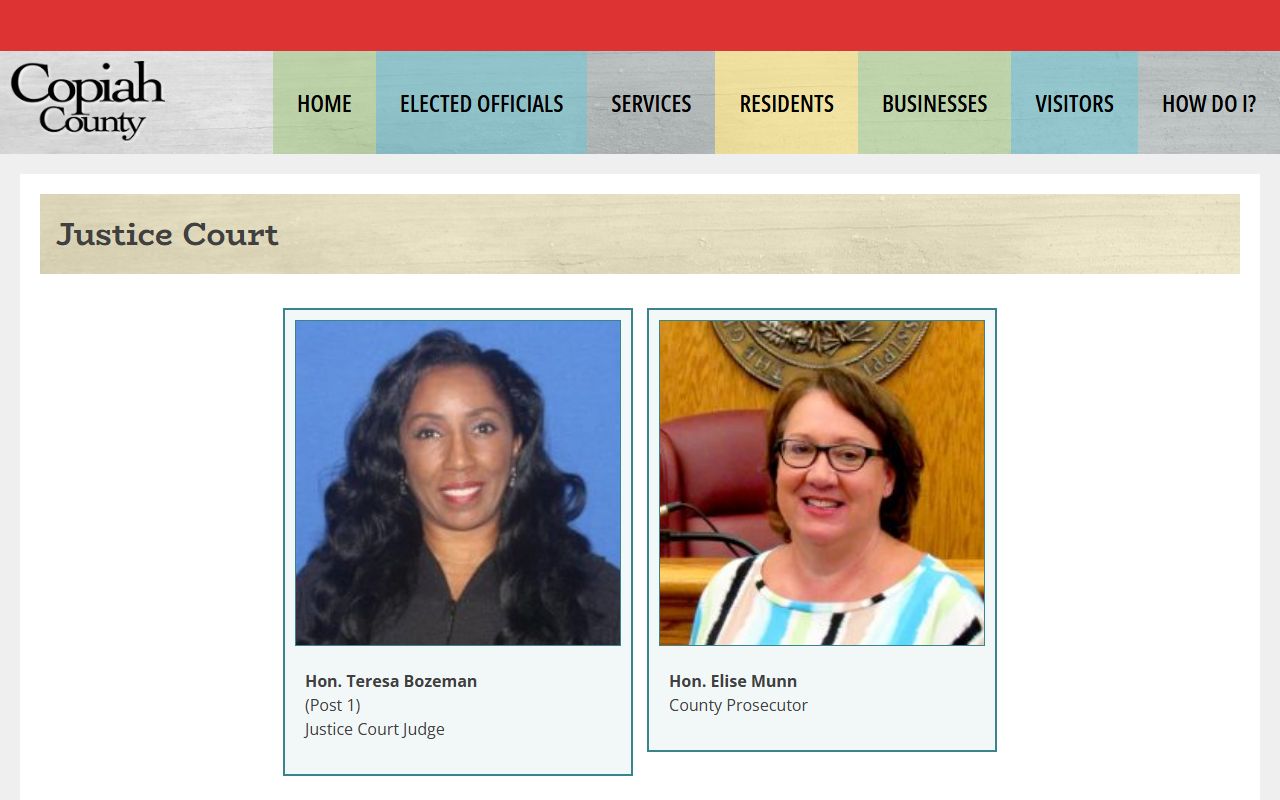
The same page notes that most charges are tried close to home. The court reports that 75 percent of people who enter the system go no further than Justice Court. The schedule there is fixed and local. Preliminary hearings fall on the second Monday of each month. Contested misdemeanor hearings happen once a month on a Thursday. A detained defendant can ask, through an attorney, for a preliminary hearing to test whether there is probable cause to send a felony to the grand jury.
Charge Status in Copiah County Cases
Charges do not stay frozen. As a case moves, a charge can be amended, reduced, added, dropped, or dismissed. The status field tells you where a charge stands right now. Reading it correctly matters, because a charge that was filed is not always the charge that is active today.
| Status | What It Means |
|---|---|
| Pending | The charge is filed and the case is still open, with no final outcome yet. |
| Amended / Reduced | The prosecutor changed the charge, often to a lesser offense, before disposition. |
| Dismissed | The court dropped the charge, so it will not go forward to trial. |
| Nolle Prosequi | The prosecutor formally chose not to pursue the charge at this time. |
A dropped or dismissed charge does not always vanish from the record. The filing may still appear in the case history. Clearing it from public view usually takes a separate legal step.
Note: A charge status can change between visits, so confirm the current standing with the clerk before relying on what an old search showed.
Charges vs. Convictions
Being charged is not the same as being convicted. A charge is an accusation. It means the state believes there is enough cause to bring the matter to court. A conviction is a finding of guilt, reached by a plea or a verdict. The two carry very different weight, and treating a charge as proof of guilt is a common and serious mistake.
| Charge | Conviction | |
|---|---|---|
| Stage | Accusation | Verdict or plea |
| Burden of Proof | Probable cause | Beyond reasonable doubt |
| Public Record | Yes | Yes |
This gap shapes how an arrest record should be read. A booking can lead to charges that are later reduced, dropped, or dismissed before any finding of guilt. The charge may stay in the file even after it is resolved. For that reason, the disposition matters as much as the charge. Always check whether a case reached a conviction, an acquittal, or a dismissal before drawing any conclusion about it.
Copiah County Charge Codes and Severity Levels
Each charge is tied to a specific statute. The code points to the law the person is accused of breaking. Mississippi sorts offenses into broad levels, and the level decides which court hears the case. One arrest can produce several separate charges, each with its own code and its own status, so a record may list more than one count.
- Felony: the most serious level, prosecuted in Circuit Court.
- Misdemeanor: a lower-level offense usually heard in Justice or municipal court.
- Municipal or ordinance violation: a city citation handled by the issuing town's court.
Reading a charge correctly means checking three things at once. Look at the statute cited, the severity level, and the court where the case is heard. A charge that reads as a felony will follow the grand jury and Circuit Court path, while a misdemeanor stays in the lower court.
Statewide Charge and Criminal History Lookups
Charges and convictions can roll up into statewide systems. Mississippi does not offer a single free public criminal-history search to the general public, but several official tools cover related ground. Each one answers a different question, and none of them is the county jail roster.
The Mississippi DPS crime statistics portal reports aggregate data and lists the Copiah County Sheriff's Office among its agencies. The Mississippi Sex Offender Registry lets the public search for registered offenders by name or area. For people serving state time, the Mississippi Department of Corrections inmate search covers sentenced prisoners, not county detainees. Victims and families can track custody changes through VINE, the statewide notification service.
Public Access to Copiah County Charge Records
Mississippi treats most court charge records as public. Under Miss. Code Section 25-61-1, public records must be open for inspection unless the law says otherwise. The first stop is always the office that holds the file. Circuit charges sit with the Circuit Clerk, Justice Court affidavits with the Justice Court clerk, and city citations with the town that issued them.
Some material stays out of reach even in an open case. Miss. Code Section 9-1-38 shields work product developed among judges and their aides. When a government office wrongly denies a public record, a complaint can go to the Mississippi Ethics Commission, which reviews disputes. Judicial records, though, carry their own limits set by court rule and statute.
Sealed, Expunged, and Restricted Copiah County Charge Records
Not every charge stays public. Some records are sealed, some are expunged, and some are confidential from the moment they are created. Knowing the difference helps set the right expectation before a search begins.
- Sealed record
- Hidden from general public view but still reachable by limited officials under set conditions.
- Expunged record
- Removed or restricted under Miss. Code Section 99-19-71, so a qualifying arrest or conviction is treated as cleared.
- Youth Court record
- Confidential under Miss. Code Section 43-21-251 and released only to authorized people or by court order.
Anyone seeking to clear a charge files in the court that handled it, whether Justice Court, municipal court, or Circuit Court. Eligibility under the expunction statute is narrow and turns on the offense and the outcome. Gather the case number, the charge, the disposition, and proof that fines and costs were paid, then confirm filing rules with the clerk before you file.
Background Check Considerations
There is a real difference between a casual lookup and a formal background check. A casual search may show pending charges, dismissals, and codes that are easy to misread. A formal report used for hiring, housing, or credit must follow the federal Fair Credit Reporting Act, which sets accuracy and dispute rules. A charge that was dropped should never be treated as a conviction.
Important: This site is not a consumer reporting agency under the FCRA, and its records may not be used to decide employment, housing, credit, or insurance.